Pages

Showing posts with label Book Review. Show all posts

Friday, 20 January 2017

Effective School Governance by Mark A'Bear


Very few people know exactly what they are letting themselves in for when they join a school governing board. I certainly didn't. 

Whatever your preconceptions may be, you'll find that it isn't quite as you imagined. Your admirable desire to 'make a difference' will have to be channeled through the appropriate decision making processes.

You may have skills that could be of use to the board, but knowing how to apply them in the context of governance is another matter. For example, the role of a governor with accountancy expertise isn't to do the school accounts. That's the business manager's job. But your background may help you enhance the board's ability to ensure value for money is achieved in the use of school funds. That's the idea, anyway. 

The same applies whatever one's work experience or skill set. Governors aren't there to do stuff, but to decide what important stuff needs doing and ensure that it's done well. In the jargon, governance is a strategic, not operational role. 

If  that doesn't appeal, there are always other things people can do with their time. 

Mark A'Bear would agree. He even has a chapter on 'When should you not become a governor?' But there are many good reason for becoming one, and those who do should want to maximise their effectiveness. 

Good governance makes a difference by giving a school a clear sense of direction, and then ensuring progress is being made towards the direction that has been set.

It's all about vision and strategy. 

Simples. But how do you go about creating a compelling vision for a school, how may governors contribute to the strategy devised to make that vision a reality, and how can they tell if the vision is being achieved? 

That's where A'Bear's book comes in. He breaks down the essentials of governance into their component parts, chapter by chapter, and puts them all back together again at the end. A bit like James May does on the telly with Hornby train sets, or electric guitars, but in this case the author is working with the concepts and procedures of school governance. 

All the key parts are here, including who should govern, stakeholder engagement, operating strategically, establishing accountability, governance structures, the roles of the chair and clerk, Ofsted preparation, and more besides. 

A'Bear writes in a  clear, crisp and accessible way that will not leave new recruits to the world of governance scratching their heads. More experienced colleagues will find his guide a useful primer and source of best practice.

The recent Ofsted survey report, 'Improving Governance' suggested that lack of self evaluation is a common feature of weak governance. This book is a self evaluation aid in itself and contains some of the key documents that have been produced to help governing boards evaluate their effectiveness. Such as the All Party Parliamentary Group's 20 questions for governing boards and an equivalent 21 questions for MAT boards (Appendix V). Governors would do well to use the material in this book to help them reflect critically on how their own systems of governance measure up. If we don't, Ofsted certainly will next time they come a-knocking. 

A'Bear has governed in both primary and secondary sectors, but those involved in governance at secondary level will notice some gaps in his coverage. For example, newly appointed secondary colleagues could probably do with having things like Attainment 8, Progress 8, EBacc, and Sixth Form accountability measures included in the glossary alongside info on SATs and Sports Premium Funding. Can't have it all, I suppose. Maybe such gaps can be made good in a second edition?

As the author acknowledges, it isn't easy to keep up with the rapidly changing world of education in England. He does his best to ensure that his treatment is up to date, addressing both the LA maintained and academy sectors. He also has a word or two to say about the shiny new world of multi academy trusts (MATs). Greater attention is given to governance in the maintained sector, however, with details provided of the different categories of governor in LA schools that don't apply in academies. Little is said about the roles of members, trustees and local governors in a MAT. The main functions of governance apply whatever the type of school, but more academy-specific information wouldn't have gone amiss.

The government has made it clear that it would like to see all schools become academies, with MATs the preferred model. According to the Department for Education, 97% of schools converting to academies in the last couple of years have joined MATs (see here). In his foreword to the new Governance Handbook Lord Nash urges schools to consider the benefits collaborating within MATs. The model is central to the DfE's vision of a 'school led system'. MAT-land is the direction of travel for education in England.

A key question for governors of LA schools is whether they will take the initiative and form a MAT with other like-minded local schools, or wait until they have to join an already established one to avoid being left high and dry. It would have been useful had A'Bear given some guidance to schools in making that choice, or at least flagged up the excellent materials provided by the National Governors' Association created to help governors make informed decisions regarding academisation options - see here and here (subscribers only). 

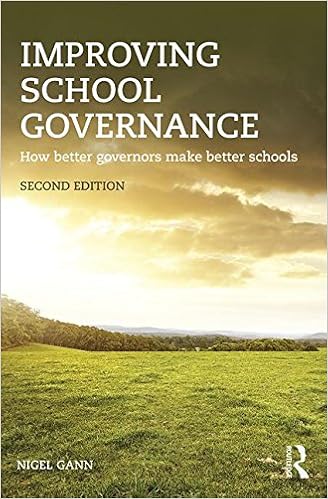
A'Bear's Effective School Governance lacks the political dimension present in its nearest equivalent on the market, Improving School Governance by Nigel Gann (Routledge, 2016). The latter title could almost be styled A Guardian Reader's Guide to Governance. You won't find a critique of Thatcherite educational neoliberalism and its deleterious effects on schooling in A'Bear's volume. Both books cover similar ground when it comes to the practicalities. Gann is stronger on the history of school governance. But I'd probably want to place Effective School Governance into the hands of a new colleague ahead of Gann's lengthier work.

Educational structures in England are in a state of flux at the moment and school governance is being shaken up as the system moves towards wholescale academisaion. This timely book is a reminder that good governance makes a difference and sets out exactly what that looks like in practice. Let's ensure for the sake of our pupils' education that school governance at all levels is as powerfully effective as it can be. That's certainly one of the things that needs to happen if we are going to construct a school led system in which every child exceeds their expected potential.

* I am grateful to the publishers for providing a complementary review copy. 

Thursday, 9 June 2016

The Chair's Handbook NGA Guide


The Chair's Handbook: A guide for chairs of school governing boards,
Gillian Allcroft & Emma Knighs, National Governors' Association, 5th Edition, 2016, 72pp

I didn't especially want to be Chair of Governors. I joined our school's governing board as a Parent Governor, not really knowing much about governance. The existing chair seemed pretty well established and didn't look as though she was going anywhere. Only I was wrong about that. One FGB she suddenly announced that she was standing down. Soon. By that time I'd only been a governor for a year (since January 2012) and didn't feel up to taking on the role. Neither did anyone else for that matter. "Would anyone like to be considered as chair?" asked the outgoing one. The wind whistled around our ears like in that tense moment after a gunfight in a cowboy film when the Colt 45s have fallen silent. No one made eye contact. Tumbleweed rolled across the boardroom floor. "That's a 'no', then." Certainly was.

The LA was approached and they managed to rustle us up a recently retired headteacher to act as chair. Her main task was to oversee the appointment of a substantive headteacher, as an interim head was in place at the time. Oh, and she also had to lead us through an Oftsed inspection a couple of months after taking the chair. We were judged Requires Improvement. Another thing was to spot a successor from our own number. A substantive headteacher was appointed, with Dr. Riding due to start in September 2013. That job done, the chair could now concentrate her efforts on digging an escape tunnel. Cue 'Great Escape' music. 

Only I was the escape tunnel. Won't bore you with the details, but I was persuaded that I was the right man for the role and was duly elected to serve as chair in July 2013. Steep learning curve. You don't know what it's like to be chair until you're it. The clerk is calling for a decision. The headteacher wants to discuss how best to handle a tricky situation. Then there's the board. You have to ensure that they become a strategic leadership team, united behind a common vision, working with the Headteacher in pursuit of shared goals. Now you can't become aware of an 'issue' and think, 'Oh I'm sure someone else will see to that', because if you don't get it seen to, it's likely no one will. 

I was used to chairing meetings and leading a group of volunteers, which was a good start. Those bits are part and parcel of my role as a Baptist Minister. The Church Members' Meetings which I chair as pastor have formal agendas; the church's vision, goals and activities are discussed, accounts received and so on. But those were the only types of meetings that I'd ever chaired. I was a bit worried that I'd begin my first FGB in a non-denominational school by saying, "Let us pray" and finish up pronouncing the benediction. Thus far I've managed to avoid confusing pulpit and chair.

When Ofsted came to call in February 2015 they found the GB in much better shape. The school was judged 'Good' with many outstanding features. We're forging ahead with our ambition to ensure that the school is a world class centre for teaching and learning at the heart of the local community. But there's still a lot to do and I'm going to need to be at the top of my game as chair to ensure that the governing board plays its part effectively. That's why the NGA's The Chair's Handbook is such a useful publication. For newbie chairs it is an invaluable guide to help you get a handle on a role that has in all likelihood been thrust upon you. For more experienced colleagues, the work offers an opportunity for us to review what we do against the models of best practice offered here. 

In crystal clear prose and with the help of user friendly diagrams the guide focuses on on seven crucial areas for chairs: 1. Leading governance in schools. 2. Leading and developing the team. 3. The chair, the headteacher and accountability. 4. Leading school improvement. 5. Leading governing board business. 6. Becoming the chair. 7. Leaving the chair. This edition is fully up-to-date, including when required, differentiated advice for chairs of governors in maintained schools, Academies and MAT boards. It really is a one stop shop for all things chairy.

Especially when you've been chair for a few years it's good to stand back, take stock of your work and consider what needs improving. With clinical accuracy authors Gillian Allcroft and Emma Knights expose chairing shortcomings that need correcting. I tend to be quite self-critical anyway so reading stuff like this can be quite painful. But there we are. I suppose it's worth triggering a bout of gloomy introspection if it makes me a better chair. There's certainly nowhere to hide for poor practitioners, from control freaks who can't delegate to inadequate numptys into whose heads a remotely strategic thought has never popped. Although they don't put it quite like that.

I once heard a fellow-chair say that his role was not to give the board leadership. That kind of thing was down to the headteacher. While it's true that the head is expected to lead the operational running of the school, it's not his/her job to lead the board to which they are accountable. That is very definitely the chair's role. As the headings listed above indicate, the guide has a welcome emphasis on the chair as leader of governance. The authors state,
The chair leads the governing board, ensuring it fulfills its functions well. The culture of the board is largely determined by the chair, for better or worse. A good chair will ensure its focus is on the strategic, and it is no exaggeration to say that the success or failure of the board depends heavily on the caliber of the chair. (p. 10)
No pressure, then.

Reading The Chairs Handbook may also serve to highlight issues that have been relegated to the back burner which need to be addressed with greater urgency. Succession planning is one thing. I don't want to leave the GB in a position where they are unable to appoint my successor from among our own number. By the time I'm done, who knows what help the LA may be able to offer? 

Being chair of governors is an immense privilege and is actually rather enjoyable. Especially as you see the board growing in strength, colleagues stepping up to take on new roles, and, above all the school you serve going forwards in leaps and bounds. It also helps if you like a challenge. But more is required of a chair than well-meaning enthusiasm. They need a clear understanding of their role and the qualities needed to make a success of it. The Chair's Handbook very definitely points us in the right direction. The guide should be mandatory reading for all current practitioners and wannabes.

Thanks, @NGAMedia. An electronic version for Gold members would make it easier to share some of the excellent material for board-level discussion.  

Now to that escape tunnel. Da da dah dah dah da da...

Monday, 18 April 2016

Improving School Governance by Nigel Gann

Improving School Governance: How better governors make better schools,
by Nigel Gann, Routledge, 2016 second edition, 249pp. 

The recently published white Ppaper, Educational Excellence Everywhere landed landed like a hand grenade in the playground of educationalists. Its shock waves are still reverberating around schools and their governing boards. That's the case even though many of its headline proposals had been long trailed by the DfE, especially governance-wise. But what makes the white paper explosive is the shift from persuasion to compulsion. HMG has argued for some time that schools would be better off as academies, preferably grouped together in Multi Academy Trusts, but most have remained stubbornly attached to their LAs. Now almost all must become academies by 2022. Similarly, none too subtle hints have been dropped that the days of stakeholder governance were drawing to an end, but now the requirement to have parent governor posts on boards will be removed. Skills alone matter. (See here for my take on the value of parent governors). 

The white paper's vision is for a post-LA 'school-led system' under the auspices of MATs. In these groupings all the powers of governance reside with the MAT board. The local governing boards of individual schools function as committees of the MAT board, with as much or little power delegated to them as the MAT board sees fit.  

To say the least Educational Excellence Everywhere hasn't exactly commanded universal support, even from Conservative local Councillors and backbench MPs.  The element of compulsion for schools to join MATs and the removal of the requirement of boards to reserve places for elected Parent Governors (as opposed to governors who just happen to be parents) are key sticking points for many. Nicky Morgan has signaled that she is not for u-turning, but it may be that Education Secretary will have to give some ground as the White Paper makes its passage through parliament. 

In some ways, the publication of the DfE's white paper renders Gann's work slightly out of date, even though it is an updated second edition brought out only this year. That in itself is a mark of how rapidly the educational landscape is changing. Which is not to say that the writer fails to give attention to new developments in education and how they may impact upon governance. The last two chapters 'Schools in uncertain times' and 'The future of governing schools' hint at future possibilities and challenges, and lay down some useful 'future proof' principles. But the publication of the white paper means that governors are in need of more detailed advice on joining or setting up a MAT and what that may involve for their governing board. At the very least governors considering joining a MAT should first read this book and weigh up the extent to which they will still be governing their school after they have signed on the dotted line. 

Little work has been done on producing model Schemes of Delegation that will allow local governing boards to retain a large element of their strategic powers within a MAT set up. The National Governors' Association talks about the need to get this right, but showing what that looks like in terms of a guidance document containing various adaptable Scheme of Delegation models is another thing. (Their Governing Groups of Schools is useful, but provides no model SofDs). The NGA are hoping to make good this lacuna soon and a good thing too. For GBs looking to join or set up a MAT that is one of the key factors to consider. No SofD is set in stone, however, and changes may be made to the founding document by the MAT board without LGBs having a say. Many have been enticed to enter the Promised MAT-Land, only to find themselves robbed of their powers with the MAT board imperiously calling the shots. Result; some seriously disgruntled local govs. (See here for my plea for a re-balancing of the powers of MAT boards in relation to LGBs). 

Gann commends a more collaborative model of school partnerships where 'power and control are dispersed rather than concentrated' and 'local stakeholders and staff can have a sense of belonging'. But in large MATs, or 'chains' such as E-ACT those are often the very things that are lacking. These 'stretchy MATs' that link together schools scattered across England operate less like governing boards responsible for a collection of schools and more like LA's. Sir Michael Wilshaw agrees, writing in a recent memo to the DfE, "many of the trusts manifested the same weaknesses as the worst performing local authorities and offered the same excuses."

Yet the role that governing boards are meant to fulfill needs doing, both at the individual school level and in terms of an overarching MAT board. It's got to be about vision, strategy, accountability, ensuring value for money, stakeholder engagement, and so on. When governance structures start looking more like dysfunctional local authorities something has gone badly wrong. Schools are best governed individually and collectively by properly skilled and empowered local stakeholders. 

Which is why it's still worth taking a look at this thought provoking and informative book. Most everything Nigel Gann has to say about school governance is excellent. I don't propose to rattle through what he discusses in detail, though. That would mean having to write a proper review as opposed to taking the opportunity to sound off about stuff. What would be the fun in that? Anyway, as you'll see from this low-down the book's coverage is pretty comprehensive. Attention is given to the history, role and functions of governance. Sound and sensible advice on best practice is offered. One of my favourite lines was on governor training, culled from an 1878 survey of school governors (they used to call them Managers back then):
There is no training...for Managers. Many, indeed, have by great pains and application overcome this difficulty...but some do not see their deficiency, or trust to the light of Nature to make up for it, without any special effort on their own part; and much mischief is the result. (p. 17)
Let that be a warning to us all. Makes any conscientious governor  want to sign up for Governor Services training on RAISEonline immediately, or break off reading this do to a Modern Governor online module on Health & Safety. Making do with the 'light of Nature' simply won't cut it. Governors, be they co-opted for their skills, or parents should be committed to ongoing training and development to enable them to fulfill their roles properly. At its best stakeholder governance involves being fired-up enough to make a difference, and also skilled-up enough to do the job effectively.

If governing boards operated in line with Gann's guidance we would indeed have better governors making better schools. But it is possible that MATs may be set up in such a way that many of the powers of governance described by the author could be stripped altogether from local GBs. In that case they would end up as little more then 'focus groups' reporting to the MAT board, if the exist at all. A regrettable scenario to my mind. Maybe I am biased, but I believe that the rapid improvements seen at Matravers over the past few years are at least in some part due to the strength of the governing board in contributing to the school's strategic leadership. 

For our part, as a LA maintained Foundation School Matravers already has many of the freedoms associated with becoming an academy. The board of governors keeps the status of the school under constant review, however, and is considering how best to respond to the policy announcements set out in Educational Excellence Everywhere. Rest assured, we will seek to ensure that any decision the board takes with regard to academisation will be in the best interests of our students and staff, and will enable us to forge a strong alliance with other schools which share our vision and values.

* I am grateful to the publisher for a providing a complementary review copy. 

Tuesday, 3 November 2015

Building Better Boards: An Opportunity for Education


Published by Wild Search

This report seeks to assess the state of school governance today and makes proposals that are intended to enable governors to respond to the challenges presented by a rapidly changing educational landscape. Governance used to be the Cinderella of schooling, receiving little attention from government ministers and policy wonks. That has now changed. The much discussed Trojan Horse affair has shown up the damage than can be done when governance goes awry. The move towards academisation, and with it the diminishing power of Local Education Authorities has placed an increasing burden on governors to monitor the performance of their school or group of schools in the case of Multi Academy Trusts. The preface by Lord Nash highlights the work of the All Party Parliamentary Group for Education Governance and Leadership. He recognises the importance of governance as an agent for  change in a school-led system. 

By 'school-led system' Nash means schools working together under the auspices of an Academy Chain or Multi-Academy Trust. The jury is out on whether academies perform better than maintained schools, especially when it comes to raising standards for disadvantaged students. But with David Cameron wanting all schools to have the 'opportunity' to become an academy by the end of the current parliament, it looks as though the drive towards academisation remains a key plank in the government's education policy. 

But if governors are going to help fill the vacuum left by the decline of LEAs they are going to have to sharpen up their act. The report emphasises the need for governors to be appointed on the basis of their skills and for existing governors to engage in high quality training and professional development. The authors are rather sniffy about Parent Governors. They would like to see a shift from the stakeholder model towards skills-based governance, as if it's a case of either the one or the other. I disagree. It is rather patronising to suggest that Parent Governors don't necessarily have the skills needed to govern. At Matravers our Parent Governors are a highly skilled bunch, but they are also passionate about seeing the school attended by their children continuing to make rapid progress. A concern about Parent Governors only being interested in the welfare and progress of their own darling children can be resolved by effective induction and training so that they understand the strategic nature of the role. The answer to the tendency for governor meetings to be sidetracked by parents raising issues to do with their children is good chairing, not getting rid of Parent Governors altogether.

The core functions of governance are: 1. Setting the Vision, Ethos and Strategy of the school. 2. Holding the Headteacher to account for the educational progress of the school. 3. Ensuring value for money. In all those areas parents have a role to play, as well as school leaders, staff,  members of the local community and governors appointed simply on account of their skills. In any case, when Parent Governor vacancies become available it is good practice for the role advertisement to include a description of the desired set of skills that a parent might bring to the table to complement the existing team. Do we really want a situation where Governing Boards are almost exclusively comprised of accountants, lawyers and high-powered business men and women? With all due respect to the good people of those professions, that would represent a considerable narrowing of the range of interests and backgrounds represented at board level. 

Attention is given to the challenges of governance in  Multi-Academy Trusts, especially in the light of the Education and Adoption Bill 2015-16. The bill will legislate to make it harder for maintained schools judged 'Inadequate' or 'coasting' by Ofsted to resist being forced to join an Academy Chain or MAT. However, recent Ofsted reports arising from the inspection of Chains and MATs suggest a mixed picture when it comes to these 'school-led systems' being able to turn around failing schools. Often the problem with poorly performing schools is not their maintained status, but ineffective leadership and weak governance. Forcing a struggling school to join a group that may share those characteristics isn't going to help anyone. Far better for a successful local school to offer school-to-school support at leadership and governance level to an underperforming neighbour. But where is the funding to facilitate that kind of thing? If MATs are the way to go, let them at least be area-wide set-ups that are the product of a shared vision, ethos and strategy, not 'marriages of convenience' with several schools in one part of the country and a few dotted elsewhere, having little in common save a bit of branding. 

The aspect of this report that garnered media interest was the proposal that governors, notably Chairs should be remunerated for their work. While reasonable expenses should be paid so that no one is left out of pocket for their efforts, I'm not sure that I would want governors to be paid. That does not make us dilettante amateurs, but 'unpaid professionals', who seek to serve as governors in local schools for the common good of the communities in which we live. Even when it comes to Chairs, either they would be offered little more than an insulting pittance for their work, or be paid so much as to change the nature of the role in a detrimental way. Chairs might be reluctant to do anything that might deprive them of 'a nice little earner' and fail to upset apple carts that sometimes need upsetting.

One area that did not receive sufficient reflection here was the professionalisation of clerking. If more is going to be expected of governors and they are to remain unpaid for their services, then governing boards are going to need the support of highly effective clerks. The role of the clerk is to offer the board procedural and legal advice and guidance, organise and prepare for meetings, take minutes and so on. Too often clerks are regarded as semi-professionals who routinely work well over their contracted hours. They are not always subject to regular performance management to help ensure their continued professional development. This needs to change. Effective clerking is essential for efficient, sharply focused and properly functioning school governance.  

I don't want to sound too negative about this report, though. That fact that governance is being given attention in a document like this is welcome in itself. There are some good things here, such as arguing the case for governors to engage in rigorous self-evaluation. The emphasis on skills and training is welcome. The pieces on The Importance of Communications and Promoting the Role of Governors are helpful enough. The findings of Building Better Boards should stimulate discussion among governors as to how we may best respond to the challenges that we face in the current educational climate. Boards would do well to review their practices in the light of the report's recommendations. While not all of the proposals found here may command agreement, they at least deserve serious thought and consideration. 

Monday, 3 March 2014

Being Strategic: a practical guide for governors by David Marriott


Being Strategic: a practical guide for school governors by David Marriott,
third edition, Adamson Publishing Ltd, 2013, 47pp, £9.95. 

'Strategic' is one of those words that when slipped into conversation can give a speaker the impression that they know what they are talking about. Say, 'Now we really need to be strategic' and everyone will nod. Try it. But there's more to being strategic than repeated use of the word. The Governing Body is meant to be the school's strategic leadership team. However, some Governing Bodies seem to be so intent in meddling in the everyday running of their school that the strategic bit is sidelined. It is then left to others to develop a compelling vision of what the school could be like and work out how to get there. Or maybe the vision thing doesn't get done at all, and a school gets stuck in the Doldrums of ever requiring improvement, but never seeming to make much headway. 

It is to help try and avoid that kind of impasse that David Marriott penned this book. He describes step by step what it means for a Governing Body to be strategic. He shows how governors can get a handle on the where their school is currently and how to work out where they want it to be in the future. Guidance is given on how to devise Vision and Mission Statements that will give governors and the school they lead a strong sense of purpose. Words like 'vision', 'values', 'mission' and 'strategy' are much bandied about in governor circles. But Buzz Words don't buzz if they are devoid of content. Marriott clearly explains what they mean in the context of the school governance. 

Being strategic involves the whole Governing Body holding the school to account accurately and objectively, checking the schools strengths and weaknesses against a wide range of evidence. It means that governors and senior leaders own a shared vision of the future prospects of the school that is informed by their values and driven by a clear sense of mission. The Headteacher will play a key role in determining the direction of the school and Marriott stresses the importance of governors developing a good working relationship with the Head that involves both challenge and support. 

Being Strategic is a helpful tool for sharpening up the practice of governance. Following Marriott's suggestion we subjected a recent Head's report to the Full Governing Body to a SWOT analysis that enabled us to get to grips with the school's Strengths, Weakness, Opportunities and Threats. Again (almost literally) taking a leaf out of this book at the next FGB we'll be asking four questions:
  • What do we want that we don't have? (need to achieve)
  • What do we want that we already have? (need to preserve)
  • What don't we have that we don't want? (need to avoid)
  • What do we have now that we don't want? (need to eliminate)
The SWOT analysis was a useful exercise in understanding where we are now. Looking at the questions mentioned above will assist us in thinking critically about the school's future. The author also includes material on governor involvement in strategic planning, target setting, policy making and much more. He manages to squeeze quite a lot into a relatively brief book that is jam packed full of good advice and helpful tips.

All current or wannabe school governors would benefit from taking a look at Being Strategic. But I think it would be of particular value to Chairs, Vice-Chairs, Chairs of Committees and those who aspire to such roles in the future. The only drawback is that at £9.95 it's a bit pricey for a slim volume, weighing in at less than fifty pages. It's a helpful book, but not quite worth it's weight in gold. Perhaps the best thing would be for a Governing Body to invest in copy or two using money from their training budget so that the book can be lent out to interested colleagues. If our School Business Manager is reading this, that was a none too subtle hint.

Highly recommended.

I'm grateful to Adamson Publishing Ltd for sending me a complimentary review copy of the latest edition of this work. 

Thursday, 17 October 2013

The Perfect (Ofsted) School Governor by Tim Bartlett

Independent Thinking Press, 2013, Print Length, 217pp, Kindle e-book

No, I'm not commending my authorised biography. Hardly. Rather, this book is meant to tell us how to becomePerfect (Ofsted) School Governor. At least that's the idea. I suppose there's no harm in aiming high, but Perfect? Even Ofsted are only after Outstanding at best. Enough quibbling about the title, though. Perfection in governance might be asking a bit much, but following the advice contained in this book will certainly help governing bodies to do their job more effectively.

The book has six chapters:

1. Strategic leadership and how governors provide it
2. Good governance: the importance of self-evaluation and effective policies
3. Governor visits to the school
4. Holding the head teacher and the leadership team to account
5. Oftsed: inspections and governors
6. Appointing a new head teacher

And no less than eleven appendices. I'm not going to list them here. You can check out the book's 'Click to LOOK INSIDE' thing on Amazon if you're interested.

I wish I had read this book when I was first thinking about becoming a governor, or at least when I had just joined the governing body. It would have helped me to hit the ground running. Well, at least walking purposefully rather than wandering around looking a bit bewildered. The book explains the essentials of governance and suggests ways in which things can be done better for the good of the school.

As a new governor I often found it hard to see the wood for the trees. I suddenly found myself in an educational forest that was so densely populated with jargon-laden information that it was difficult to get a sense of perspective. To that end the book includes some useful jargon and acronym busting. Key concepts such as strategic leadership and accountability simply defined. Illustrations are given of how they work out in practice. You won't find all that you'll need to know here, but this systematic overview will bring a welcome clarity to the thinking of the most befuddled new gov.

There are lots of handy tips here on improving governance that I plan to try out on our Governing Body over the coming months. We especially need to do some work on self-evaluation, seeking feedback from governors on the usefulness or otherwise of our various meetings.

Not that I'll be implementing all of the author's suggestions. Having our longsuffering Clerk read out her minutes for governors' approval at the end of every agenda item would slow the pace of meetings unnecessary. Yes, the Chair may sometimes wish to check that a precisely worded statement has been accurately minuted. But usually the gist of what was said is sufficient and the record can be approved at the next meeting.

I'd certainly urge that all wannabe and newbie governors have a read of this book. Battle scarred veterans of many a Full Governing Body meeting might learn a thing or two as well. In addition, it wouldn't hurt for the Senior and Middle Leaders who attend our sessions so we can subject them to Paxmanesque interrogation to give the book a once over so they can familiarise themselves with the principles and processes of school governance.

To return to the book's somewhat misleading title, I doubt whether our or anyone else's governing body will ever achieve an idealised state of Platonic perfection, but that doesn't mean that we can't improve our practice. Governors expect the school they serve to be constantly making progress. As agents of reform, governing bodies need to be perpetually reforming themselves. Perfect? Never. Better? Absolutely. But then, had the title been, The Better (Oftsted) Governor, it probably wouldn't have caught my attention when browsing for something governory to read on Amazon.

A hardback edition is available for any without a newfangled e-reader device (see here).

Highly recommended.