Pages

Monday, 29 June 2015

Parent Power (Home-School Agreement consultation)

At Matravers we believe that it is our role to educate children with their parents rather than for their parents. Our Home-School Agreement (HSA) acknowledges the importance of parent power in education saying,  ‘[Parents/Carers] are the primary educators of [their] children’. With that in mind we wished to consult parents and carers when it came to updating some of the wording on that document.

I take it that the vast majority of parents and carers were happy with the new version. We made it clear when asking for their views that we would take 'no response' as a sign of agreement. In all he consultation elicited 9 responses. Of those 9, 1 was in full agreement, 2 made no comments, and 6 included various points. We have changed the wording of the HSA reflect some of the constructive criticism from parents/carers.

As we expected, the point that proved most controversial was the one where we ask parents and carers to:

•           Refrain from using social networking sites to discuss sensitive issues or complaints relating to the school.

There are a number of reasons why we updated the HSA to make reference to social media. When speaking to a Pupil Voice Panel at a recent Governor Visit Day it became evident that students’ pride in their school was being dented by negative comments about Matravers on social media sites. The Ofsted Report noted, “A small minority of parents do not recognise the rapid improvements made by the school.” That's a shame, but so much is evident from comments made on certain social networking sites.

Further, if a parent or carer wishes to avail themselves of the official Complaints Process, matters aren’t helped if they have already discussed their complaint on social media. Under Stage 3 of the process complainants have the right to appeal against the Chair of Governors’ decision to a panel of three governors. According to the Complaints Process those governors must not be tainted by ‘prior involvement in or knowledge of the case’. It makes it a bit difficult to ensure we can do that if the complaint has been the subject of comment on social media and has then been taken up by the local press. Parents are depriving themselves of due process when they 'discuss sensitive issues or complaints relating to the school' on social media and then wish to make a formal complaint using the proper channels.

A couple of respondents suggested that having parents and carers sign up to the point in question is a breech of their civil right to free speech. However, asking parents and carers to agree to forbear doing something is not the same as trying to force them to do so. We have no power or wish to do that. But we think that it is reasonable to ask parents and carers to refrain from tarnishing the reputation of the school to which they have chosen to send their children by making negative comments about Matravers on social media. Especially given the impact that kind of thing has on our students. Fair enough? 

Another complained that it is patronising to request that parents agree not to, "discuss sensitive issues or complaints relating to the school" on the internet. I respectfully disagree. Should a member of staff criticise the school on social media, up to and including the Headteacher, they would face disciplinary action. Students who do so have been warned that they will be suspended from the school. Governors who comment on matters relating to the school on social media know that they will soon find themselves ex-governors. I for one can't see how it is patronising to ask parents to act in the same responsible manner as staff, students and members of the Board of Governors when it comes to social networking. 

As the consultation revealed, the vast majority of parents and carers support the updated Home School Agreement. Of those who responded, only three expressed reservations about the point on social media. The objections don’t stack up and there are very good reasons for asking parents and carers to abide by this commitment.  

As their children’s primary educators parents and carers have great power. But as Spiderman’s uncle often admonished him, ‘With great power comes great responsibility’. 

Tuesday, 16 June 2015

Jenny Clements (1940-2015) - A Tribute

We were very sad to hear of the death of Jenny Clements last Friday. She was a great servant to the Matravers Board of Governors. She was Vice Chair of the Board and Chair of our Every Child Matters committee for many years.

Jenny will be greatly missed by all who knew her at the school. It was her abiding interest in the welfare and wellbeing of the children and young people of the Westbury area that led Jenny to devote so much time and effort to school governance. With friends at Westbury Infants and the Manor School, Melksham we will feel her loss very keenly.

Jenny had a special concern for disadvantaged children and young people. As noted, she was chair of ECM. The committee’s title stemmed from educational agenda of a previous government and there was some talk of renaming it, but Jenny was adamant, Every Child does Matter and so it remained. As a governor Jenny was capable contributing to discussions on school strategy and immersing herself in the finer points of data reports, but she never allowed us to forget that it was all about the children.

Jenny was not only involved in school governance. Amongst other things she was involved in the Hospital League of Friends, Westbury Lions, and the United Reformed Church. It was her faith that inspired her to spend her life in service of the people of the Westbury area. Jenny wasn’t a great one for email. My correspondence with her was decidedly one sided, but her email address was ‘JennyWestbury’, which kind of says it all.

It’s difficult to imagine governance at Matravers without Jenny’s steadying presence, but she would want us to press on with our quest to ensure that the school provides the outstanding education that the young people of our area deserve. I for one will miss Jenny’s wise counsel, forthright manner and good humour. It was a privilege to have know her and worked alongside her.  

Monday, 11 May 2015

The end of the beginning

Image result for ofsted good 2015

"Good things come to those who wait", my mum used to tell me. I was never quite convinced by that particular piece of maternal wisdom. Like "cleanliness is next to godliness", it didn't seem always to ring true. But maybe there was something in it after all. We've been waiting for the publication of the school's Ofsted report since the inspectors came to call in February, with a follow-up visit in April. But now, at last, it's out (see here). Staff were briefed on the report last week. Hopefully parents have received their copy and I hope you've been able to give it a once-over. 

Since Ofsted first visited in 2001 Matravers has only ever been judged a Grade 3 school; 'Satisfactory' in old money, or 'Requires Improvement' as it's called in Wilshaw era. So it's pleasing to note that  we were judged Grade 2, or 'Good' at the most recent inspection. That's quite a turn-around considering the work that needed doing in the school as highlighted in the previous inspection report from February 2013. It is tribute to the outstanding leadership of our headteacher, Dr. Riding, and the hard work of our dedicated staff and remarkable students that things have moved so far so fast. Thanks too to fellow members of the Board of Governors and our clerk for doing their bit. A big well done one and all!

Did you notice the number of times the word 'outstanding' is used in the report, or 'at least good', or the repeated mention of 'rapid improvements', all hallmarks of a Grade 1 'Outstanding' school? There is an old saying, 'If it quacks like a duck, walks like a duck and swims like a duck, it's a duck'. But it seems that for now we'll have to be content with 'Good', notwithstanding the many outstanding features of the school highlighted in the report.   

By a strange coincidence the report was published on 8th May, which date also marked the 70th anniversary of VE Day. Over the weekend the nation celebrated the memory that momentous occasion. With the benefit of hindsight the allied victory in WWII seems almost inevitable in the wake of the success of the D-Day landings in the June of the previous year. But early on in the war the outcome was far from certain. Battle after battle was lost by British forces. A turning point was the victory of the Eighth Army over Rommel's Battalions at the Battle of El Alamein. Churchill reflected, "Before Alamein we never had a victory. After Alamein we never had a defeat." At the same time the war leader knew that there was still a long way to go before victory was finally secured. He cautioned, "Now this is not the end. It is not even the beginning of the end. but it is, perhaps, the end of the beginning." And so it was.

Similarly, we don't regard being judged 'Good' at long last as the end of the journey. It merely marks, we trust, the end of a new beginning for the school. We aim to be 'Outstanding', not mainly for the kudos of receiving the ultimate Ofsted accolade, but for the sake of our students. We want them to enjoy an outstanding education that will give them the values, skills and qualifications they need to make it in the big wide world. Can we rest content with anything less for the young people of the Westbury area? 

Monday, 9 March 2015

Fire and Skill

What was I saying now? Got distracted for a minute. More like three months to be exact [since the last post]. But a lack of activity on the blog front doesn't mean stuff hasn't been happening in gov-land. It has. Lots of stuff, actually. All a bit of a blur really. I have a foggy memory that before Christmas senior governors had a high powered meeting with the Headteacher and School Improvement Advisor and then enjoyed  a slap-up Christmas dinner in the canteen with all the trimmings. Crackers included. After that we attended a CVQO awards ceremony to watch students receive their certificates from military top brass. All in the same day. 

After Christmas Oftsed came to call. And things haven't quite been the same since. Whoever said, 'all publicity is good publicity' evidently wasn't familiar with some of the stuff trotted out in the media around these parts. Less said on that front the better, I think.

School uniform. Some people have difficulty in accepting that our students made the running in wanting to change from the existing get up to blazers and ties. I mean, it's daft to think that they could have such high aspirations for themselves. Much easier to believe that the move was a dastardly plot dreamed up by the Headteacher with the connivance of the Governing Board. Westbury children wanting to look as smart as any school kid out there, whatever next? But they do, with 65% of our students backing the change. Good on them, I say. 

The school production Singing in the Rain was brilliant. Well acted, brilliantly staged and with some great singing. Still haven't worked out how they did the rain special effect. 

Last week it was back to school for the govs for another Visit Day. I attended History and Geography lessons. In History the subject was the American West; Cowboys and Indians and that. The lesson involved an interactive quiz using clicky things that resemble a TV remote, but can do more than just change channels and adjust the volume. A governor colleague and I got 60% between us. Mostly due to inspired guesswork on our part, I must admit. In Year 7 Geography one task was colouring in maps of the UK according to population distribution, but I didn't get to have a go at that. Just as well, as I was always hopeless at colouring between the lines.

During the Visit Day we also held some Pupil Voice panels in order to get students' perspectives on the school. We were not only interested in whether they are making academic progress in relation to their targets, but also what fires them up about education, and whether their time at school is helping to prepare them for life in the big wide world.

Last Friday night my wife and I went to see a Paul Weller concert in Swindon. The Modfather was in fine form. As teenager I was really into The Jam; Eton Rifles, Going Underground, Town Called Malice and all that. The band's motto was, 'Fire and Skill'. It was meant to encapsulate The Jam's explosive mix of fiery passion and skillful playing ability. And that kind of sums up what we're trying to do at Matravers. Not simply to give our students the right skills and knowledge, but also fire up their ambitions and give them a strong sense of moral purpose so that they will be the kind of people who make a difference to the world in which we live.

 'Matravers for education with fire and skill'.

Tuesday, 2 December 2014

Governor Visit Days

Last Wednesday governors conducted their first Visit Day of the academic year. Each governor is allocated a 'link' either to a subject or department of the school. Governors appreciated having an opportunity to talk to staff about progress that is being made the areas to which they are linked. 

Colleagues also enjoyed visiting lessons and were pleased with the positive behaviour for learning that they witnessed. I visited History and PE lessons, which were very different (not so much jumping through hoops in History), but both great. The History lesson was about the religious causes of the English Civil War. While I'm no historian I've studied that period a little and and it took great self control on my part not to keep putting my hand up and saying, 'Please Miss...' in answer to questions posed by the teacher. I was content simply to watch PE students enjoying themselves jumping through hoops, though. Thanks to hardworking members of staff for taking the time to meet with governors and for welcoming us into their lessons. 

We especially valued having the opportunity to speak with panels of students from all Key Stages about some of the changes that have been introduced at Matravers since September. It was good to hear their views, which were expressed in such a spirited, frank and thoughtful way. They had many positive things to say about the school, which was encouraging. We are grateful to our exceptional students for giving us their own unique perspective on the school.

We will reflect on feedback from the Visit Day at the Full Governors’ Board meeting on 9th December. We will be discussing what we learned from conversations with staff and students in our forthcoming committee meetings.

The governing board is grateful to everyone who made the Visit Day such an enjoyable and informative experience for all who took part. 

Monday, 13 October 2014

Governance is a 'thinking not doing role': discuss

School governance is a strategic rather than operational task. Governors don't run the school. They tell the school where to run and make sure it’s on track to get there. To help safeguard the strategic/operational divide the National Governors' Association defines governance as ‘a thinking not a doing role’. I would want to develop that definition a little as it may give the misleading impression that governors simply sit around quietly thinking about things. We tend to be a mouthy lot and have been known to vocalise our thoughts in speech. Just occasionally.

It would be more accurate therefore to say that governance is ‘a speaking not a doing role’. But even that is open to misunderstanding, as it makes governor board meetings sound like a glorified talking shop. What to say, then? I think we need to break down the thinking/doing, speaking/doing dichotomy that is inherent in the NGA's definition and my suggested alternative. We may profitably do that by drawing on the insights of ‘speech-act theory’. 

'What's that when it's at home?' I hear you ask. Well, 'speech-act theory' is the understanding of linguistics developed by Oxford academic J. L. Austin. The brainy prof cautioned that speaking is not to be set in opposition to acting. Rather, speech is a form of action that has practical effects.  Austin proposed that language may be broken down into three component parts: First we have basic units of speech, or words. Second there is the use to which we put our words, such as as making promises, or issuing commands. Finally, what we do with our words has an effect upon others as promises believed, or commands are obeyed. That in essence is 'speech-act theory'. 

Words then are not ‘just words’. When we speak we are engaging in ‘communicative action’, to use the jargon.  For example, you order a home delivery pizza over the phone, promising to pay for it on when it comes. It arrives piping hot 30 minutes later (hopefully) and you eat it.  Your words of promise and command spoken to the person in the pizza shop did something. They were communicative acts that made stuff happen in the real world. 

Now for a thought experiment in an attempt to apply the insights of 'speech-act theory' to the role of governance. To return to our pizza illustration, it isn’t the job of governors to cook the thing. That's the operational bit. If the school were a giant pizza parlour, staff and students would produce the goods, not the governors. We set the strategy by ordering the exact kind of pizza we want and then hold the head to account to make sure we get what we ordered. Governance is more than a ‘thinking role’ because we don't just idly dream of the educational equivalent of great pizza. We use words to order it. It involves more than aimlessly sounding off, because our speech is intended to have a practical effect upon the school: the production of outstanding pizza student achievement

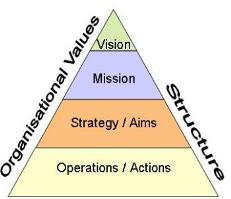
Without the aid of Italian fast food, it works like this. The governors' Statement of Vision and Values sets the school's destination of travel. Our strategy provides the ‘route map’ that will help us get there. It includes detailed coordinates such targets for exam results, improvements in student behavior and attendance, and enhancements to the quality of teaching. By setting the vision and strategy and holding the head to account against key performance indicators governors help keep senior leaders on their toes, thus driving forwards the process of school improvement. And so it is that the words we use have the desired impact on our students’ learning outcomes. They are not 'just words', but ‘speech-acts'. Geddit?

To bring this discussion to a conclusion, in place of the NGA’s construction of governance as ‘a thinking not a doing role’, I propose that governance should be defined as a ‘strategic speech-act’. Admittedly it may not catch on as a snappy slogan. But putting it like that safeguards the strategic/operational divide without the danger of implying that governance is all thought/talk and no action. We speak therefore we do. The communicative actions of the board promote high standards of educational achievement in order to ensure that every student exceeds their potential. 

For evidence of the impact of the board's 'strategic speech-acts',  check out the Board of Governors' Report to Stakeholders 2013/14 that will be sent to parents and carers at the end of this term.

Monday, 29 September 2014

Blog Exclusive: The Parent Governor Interview

We currently have two Parent Governor vacancies on the Board of Governors. In this interview I chat to current Parent Governor Joanne Russell about the challenges and rewards of governance. 


GD: Hi Joanne, please tell us a little about yourself:

JR: I am self-employed running a small beauty business from my home. I have 3 sons, the older 2 attended Matravers a few years ago and my youngest has just started Year 9.

GD: What made you want to become a governor, and when did you join the board?

JR: I joined Matravers Governors as a Parent Governor in June 2013. Since my youngest son had joined Matravers there had been a lot of changes and I knew, with a new Head Teacher starting there would be a lot more. I’d had many conversations with friends and other parents and generally we all seemed to be discussing the same subjects. A letter was sent out asking for Governors and I decided that this would be a good opportunity for me to understand and discuss issues and be a voice for other parents.

GD: What is the role of the Board of Governors?

JR: The Board of Governors takes responsibility for the conduct of the school. It promotes high standards of educational achievement in order to ensure that every student exceeds their potential. Our ambition is for Matravers School to become a world class education facility at the heart of the Westbury area community for students aged 11-18. In addition the board has legal ownership of the school site (land and buildings) and acts as the employer of school staff.

The Core Functions of Governance are:
  • Ensuring clarity of vision, ethos and strategic direction
  • Holding the headteacher to account for the educational performance of the school and its pupils
  • Overseeing the financial performance of the school and making sure its money is well spent.
That may sound very daunting but this is done as a team and we work together.

GD: What have you found most challenging about governance?

JR: For me, the most challenging thing about Governance is understanding data! I am getting there but it does not come naturally!

GD: What have you found most rewarding about governance?

JR: Before becoming a governor I didn’t really understand what the role of the Governing Board was, I have a good understanding now, but more importantly I’ve learned that they are a group of ‘ordinary’ people who care passionately about the success of Matravers and the children that attend it.

GD: What skills have you learned from being a governor that have helped you in other areas of your life?

JR: I now have a broader view of the education system and some of the challenges faced with running a school, I was probably quite narrow minded with my views on certain issues prior to becoming a Governor.

GD: How does being a parent impact on your approach to governance?

JR: I think being a Governor and having a child that currently attends Matravers is a great benefit. I am listening to feedback from my child regarding things that are going on at the school, I have the benefit of talking to other parents and being able to feedback not only concerns but also positivity to the Governing Board.

GD: What would you say to encourage other parents join the Governing Board?

JR: There is often a lot of talk between parents and also in the community about Matravers, people are often very passionate with their views whether they are positive or negative. Put this passion to good use and consider being a Governor and joining the Governing Board, where issues can be dealt with constructively.

GD: Thanks for that, Joanne. For more information on becoming Parent Governor and how to apply see the Governor page of the school website, here