Pages

Tuesday, 2 December 2014

Governor Visit Days

Last Wednesday governors conducted their first Visit Day of the academic year. Each governor is allocated a 'link' either to a subject or department of the school. Governors appreciated having an opportunity to talk to staff about progress that is being made the areas to which they are linked. 

Colleagues also enjoyed visiting lessons and were pleased with the positive behaviour for learning that they witnessed. I visited History and PE lessons, which were very different (not so much jumping through hoops in History), but both great. The History lesson was about the religious causes of the English Civil War. While I'm no historian I've studied that period a little and and it took great self control on my part not to keep putting my hand up and saying, 'Please Miss...' in answer to questions posed by the teacher. I was content simply to watch PE students enjoying themselves jumping through hoops, though. Thanks to hardworking members of staff for taking the time to meet with governors and for welcoming us into their lessons. 

We especially valued having the opportunity to speak with panels of students from all Key Stages about some of the changes that have been introduced at Matravers since September. It was good to hear their views, which were expressed in such a spirited, frank and thoughtful way. They had many positive things to say about the school, which was encouraging. We are grateful to our exceptional students for giving us their own unique perspective on the school.

We will reflect on feedback from the Visit Day at the Full Governors’ Board meeting on 9th December. We will be discussing what we learned from conversations with staff and students in our forthcoming committee meetings.

The governing board is grateful to everyone who made the Visit Day such an enjoyable and informative experience for all who took part. 

Monday, 13 October 2014

Governance is a 'thinking not doing role': discuss

School governance is a strategic rather than operational task. Governors don't run the school. They tell the school where to run and make sure it’s on track to get there. To help safeguard the strategic/operational divide the National Governors' Association defines governance as ‘a thinking not a doing role’. I would want to develop that definition a little as it may give the misleading impression that governors simply sit around quietly thinking about things. We tend to be a mouthy lot and have been known to vocalise our thoughts in speech. Just occasionally.

It would be more accurate therefore to say that governance is ‘a speaking not a doing role’. But even that is open to misunderstanding, as it makes governor board meetings sound like a glorified talking shop. What to say, then? I think we need to break down the thinking/doing, speaking/doing dichotomy that is inherent in the NGA's definition and my suggested alternative. We may profitably do that by drawing on the insights of ‘speech-act theory’. 

'What's that when it's at home?' I hear you ask. Well, 'speech-act theory' is the understanding of linguistics developed by Oxford academic J. L. Austin. The brainy prof cautioned that speaking is not to be set in opposition to acting. Rather, speech is a form of action that has practical effects.  Austin proposed that language may be broken down into three component parts: First we have basic units of speech, or words. Second there is the use to which we put our words, such as as making promises, or issuing commands. Finally, what we do with our words has an effect upon others as promises believed, or commands are obeyed. That in essence is 'speech-act theory'. 

Words then are not ‘just words’. When we speak we are engaging in ‘communicative action’, to use the jargon.  For example, you order a home delivery pizza over the phone, promising to pay for it on when it comes. It arrives piping hot 30 minutes later (hopefully) and you eat it.  Your words of promise and command spoken to the person in the pizza shop did something. They were communicative acts that made stuff happen in the real world. 

Now for a thought experiment in an attempt to apply the insights of 'speech-act theory' to the role of governance. To return to our pizza illustration, it isn’t the job of governors to cook the thing. That's the operational bit. If the school were a giant pizza parlour, staff and students would produce the goods, not the governors. We set the strategy by ordering the exact kind of pizza we want and then hold the head to account to make sure we get what we ordered. Governance is more than a ‘thinking role’ because we don't just idly dream of the educational equivalent of great pizza. We use words to order it. It involves more than aimlessly sounding off, because our speech is intended to have a practical effect upon the school: the production of outstanding pizza student achievement. 

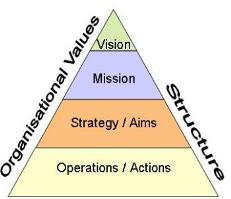
Without the aid of Italian fast food, it works like this. The governors' Statement of Vision and Values sets the school's destination of travel. Our strategy provides the ‘route map’ that will help us get there. It includes detailed coordinates such targets for exam results, improvements in student behavior and attendance, and enhancements to the quality of teaching. By setting the vision and strategy and holding the head to account against key performance indicators governors help keep senior leaders on their toes, thus driving forwards the process of school improvement. And so it is that the words we use have the desired impact on our students’ learning outcomes. They are not 'just words', but ‘speech-acts'. Geddit?

To bring this discussion to a conclusion, in place of the NGA’s construction of governance as ‘a thinking not a doing role’, I propose that governance should be defined as a ‘strategic speech-act’. Admittedly it may not catch on as a snappy slogan. But putting it like that safeguards the strategic/operational divide without the danger of implying that governance is all thought/talk and no action. We speak therefore we do. The communicative actions of the board promote high standards of educational achievement in order to ensure that every student exceeds their potential. 

For evidence of the impact of the board's 'strategic speech-acts',  check out the Board of Governors' Report to Stakeholders 2013/14 that will be sent to parents and carers at the end of this term.

Monday, 29 September 2014

Blog Exclusive: The Parent Governor Interview

We currently have two Parent Governor vacancies on the Board of Governors. In this interview I chat to current Parent Governor Joanne Russell about the challenges and rewards of governance. 


GD: Hi Joanne, please tell us a little about yourself:

JR: I am self-employed running a small beauty business from my home. I have 3 sons, the older 2 attended Matravers a few years ago and my youngest has just started Year 9.

GD: What made you want to become a governor, and when did you join the board?

JR: I joined Matravers Governors as a Parent Governor in June 2013. Since my youngest son had joined Matravers there had been a lot of changes and I knew, with a new Head Teacher starting there would be a lot more. I’d had many conversations with friends and other parents and generally we all seemed to be discussing the same subjects. A letter was sent out asking for Governors and I decided that this would be a good opportunity for me to understand and discuss issues and be a voice for other parents.

GD: What is the role of the Board of Governors?

JR: The Board of Governors takes responsibility for the conduct of the school. It promotes high standards of educational achievement in order to ensure that every student exceeds their potential. Our ambition is for Matravers School to become a world class education facility at the heart of the Westbury area community for students aged 11-18. In addition the board has legal ownership of the school site (land and buildings) and acts as the employer of school staff.

The Core Functions of Governance are:
  • Ensuring clarity of vision, ethos and strategic direction
  • Holding the headteacher to account for the educational performance of the school and its pupils
  • Overseeing the financial performance of the school and making sure its money is well spent.
That may sound very daunting but this is done as a team and we work together.

GD: What have you found most challenging about governance?

JR: For me, the most challenging thing about Governance is understanding data! I am getting there but it does not come naturally!

GD: What have you found most rewarding about governance?

JR: Before becoming a governor I didn’t really understand what the role of the Governing Board was, I have a good understanding now, but more importantly I’ve learned that they are a group of ‘ordinary’ people who care passionately about the success of Matravers and the children that attend it.

GD: What skills have you learned from being a governor that have helped you in other areas of your life?

JR: I now have a broader view of the education system and some of the challenges faced with running a school, I was probably quite narrow minded with my views on certain issues prior to becoming a Governor.

GD: How does being a parent impact on your approach to governance?

JR: I think being a Governor and having a child that currently attends Matravers is a great benefit. I am listening to feedback from my child regarding things that are going on at the school, I have the benefit of talking to other parents and being able to feedback not only concerns but also positivity to the Governing Board.

GD: What would you say to encourage other parents join the Governing Board?

JR: There is often a lot of talk between parents and also in the community about Matravers, people are often very passionate with their views whether they are positive or negative. Put this passion to good use and consider being a Governor and joining the Governing Board, where issues can be dealt with constructively.

GD: Thanks for that, Joanne. For more information on becoming Parent Governor and how to apply see the Governor page of the school website, here. 

Monday, 15 September 2014

Education for life

Right then, devoted readers. You no doubt will have spent so long poring over our shiny brand new Statement of Vision and Values that every last syllable has been indelibly printed the bits of your brain devoted to memorising stuff.  Am I right? OK then, I'm going to test you. What was the last 'value' on our list? Think hard now. Got it? 

Of course you did. We want our students to be characterised by dynamism. That English word is derived from the Greek δύναμις or dunamis to transliterate, meaning power. Now, power could simply be construed as the ability to bend others to your will; 'might is right'. That's diabolical dynamism and is not something we're overly keen to promote. Rather, as one of our key values, dynamism is defined as,
Ensuring that our students grow and develop into well-rounded, reflective individuals with a strong sense of moral purpose. By doing so we encourage them to contribute positively to the world in which we live.
High minded talk of 'moral purpose' may seem a little old fashioned. Quaint even. Could have been written by a Vicar or something. But a number of recent studies have highlighted the importance of education as an exercise in character formation. Students don't simply need to learn English, Maths, History, Physics, Dance, Drama, or whatever so they can pass their exams. According to a report commissioned by the CBI, schools also need to teach character to children and be judged on their success in doing that by Ofsted. 
Speaking in an interview with The Times to mark the launch of the report John Cridland, director-general of the CBI argued that schools should teach pupils resilience [also one of our values] and how to be “rounded and grounded”. Any school failing to do that should not be rated Outstanding, he said, even if it achieved great results. Cridland went on to spell out what he meant by 'character', 
I mean resilience, humility, emotional intelligence, team spirit, someone who will go the extra mile... Some young people are surprised by the workplace. This generation is the most streetwise there has ever been . . . so how can they be the least ready for the world of work? There’s a disconnect between the workplace and what they think it looks like — it is more informal and a collective team effort than they realise.
It seems that Ofsted head honcho, Sir Michael Wilshaw agrees saying,
Too many teenagers leave school without having learnt how to dress smartly, speak politely, and turn up for work on time [and that] young people were not well enough prepared for work, contributing to high levels of youth unemployment. The Times [paywall protected]. 
Our rigorous approach to matters such as school uniform and punctuality is designed to ready our students for the disciplines of working life. Of course we want to teach our pupils the knowledge and skills they need to succeed academically. But that is not enough on its own. We will also endeavor to inculcate key character-forming values and virtues that will help shape our students into 'rounded and grounded' individuals with a strong sense of moral purpose. That's because at Matravers we believe that education is not just for school, but for life. 

Monday, 8 September 2014

The Vision Thing


Before I say anything else I should congratulate students on their exam results and thank staff for all the hard work they put in during the course of the previous academic year. Welcome to new students who have just started with us and welcome back to all who have returned after the summer break. On behalf of the governors I wish you every success in 2014/15 academic year. As we stand at the threshold of a new school year I thought now might be a good time to reflect on the Board of Governors' vision for Matravers School. 

George Bush senior was famously dismissive of what he called, 'the vision thing'. He was a detail rather than big picture man and had little time for high faluting visionary ideas. There's something to be said for such a down to earth, practical approach to power. But without a clear view of future prospects, strategies designed to make visions a reality become little more than tactical responses to everyday events. Organisations can easily get blow off course by every puff of wind if they don't have a very definite sense of where they are going. That's why 'the vision thing' is so important for a school.  
At a recent meeting of the Full Governing Board we reviewed and refreshed the school's Statement of Vision and Values. The statement sets out the direction of travel for the school. Our strategic 'route map' will help ensure that we get there. The role of governors is to set the vision of the school and hold the head and senior leaders to account to make sure we are not going off course. 

Vision

Our vision is for Matravers School to be a world-class centre for teaching and learning at the heart of the Westbury community. Achieving this involves ensuring that every Matravers student exceeds their potential in all aspects of their education. We will provide the outstanding teaching, learning and leadership needed to fulfil this goal. Our outreach and support of others ensures that we are working at the cutting-edge of education as a system leader
Values 
Our values are embedded in all that we do at Matravers School. We believe they reflect our approach to ensuring that our students receive the most fulfilling and rewarding education possible.
Resilience We equip our students with high quality core skills and the aptitudes to use them in order that they become independent enquirers team workers; effective participants; self-managers; reflective learners; and creative thinkers. Our inspiring teaching and learning empowers our students to meet any challenge with confidence and succeed in life.
Creativity We embed confidence and self-belief within our students by inspiring a passion for learning which extends to every member of the community. Students strive for excellence; teachers, support staff and the wider community continually enhance a flexible repertoire of skills in order to enable students to exceed expectations..
Ambition We enable our students to realise that anything is possible. There are no ceilings or limits to our aspirations.  We embrace an atmosphere of success across the whole school, which is publicly recognised and celebrated.
Happiness We recognise that every student is an individual. We care greatly for each pupil, providing them with the support and guidance they need to be fulfilled and happy.
Success We empower our students to raise their aspirations towards excellence. We ensure this happens by setting challenging targets and rigorously monitoring progress towards them.  Through our home/school partnership we engage parents in the learning success of their children.
Dynamism We ensure that our students grow and develop into well-rounded, reflective individuals with a strong sense of moral purpose. By doing so we encourage them to contribute positively to the world in which we live.

Monday, 21 July 2014

A cure for the summertime blues

Embedded image permalink
Big Picnic
Governors, eh? One minute we're painted as little more than well-meaning dolers out of sherry and cake at the school fête. The next we're dangerous subversives, bent on re-enacting the siege of Troy, only in Birmingham. Trojan horses and all that. It's enough to bring on a fit of the summertime blues for us poor, put-upon govs. 

Just to reassure worried parents, Matravers governors would never get caught up in any of that sherry and cake malarkey. No way. And we don't even have a school fête. As for Trojan horses, I was never much cop at woodwork. Besides, the siege of Troy didn't exactly end well for Achilles, did it? What with his dodgy heel and all that. Naah. We'll just have to settle for giving the school strategic leadership and accountability. That'll keep us busy enough.

Not that it's all high powered meetings, data crunching and target setting. The role does have some perks. On Thursday evening my wife and I attended the Matravers Sports Presentation Evening. What an amazing array of sporting talents we have hidden away in the school. It was great to see our top class gymnasts, athletes, footballers, netballers, bowls players and much more receive awards at the event. A special 'Well Done' to hammer thrower Elly Webb for winning the Sports Personalty of the Year!

And then on Friday (it's all go), we attended the Big Picnic. Good food. Banging tunes. Sumo suit wrestling. Didn't try that. Face painting. Didn't try that either. Queue was too big. But it was thrilling to see the school at its chilled-out (with the help of lots of ice lollies), yet vibrant best. A great cure for the summertime blues. 

Now the final term of 2013/14 is almost over. We've seen a lot of changes in the school since Dr. Riding took the helm in September. Changes for the better, I trust. Here's hoping that all the hard work of students and staff pays off come the exam results in August. Onwards and upwards. 

In the autumn we'll be publishing our first Board of Governors Report to Stakeholders (2013/14), setting out the key actions of the board and charting their impact on the school. If you can't wait for that eagerly anticipated blockbuster, don't forget my reading challenge for the hols. 

Have a great summer break! 

Monday, 7 July 2014

On creating 'a thirst for knowledge and a love of learning'


The words in quotation marks in the title of this post are taken from the Ofsted School Inspection Handbook. They form part of the Grade Description for Outstanding Behaviour & Safety of Pupils. If a school is to be rated Outstanding it isn't enough that students are compliant and well behaved. Inspectors will look for evidence that a school has awakened 'a thirst for knowledge and a love of learning' in its pupils. That's what we're aiming for at Matravers. 

But, like charity, 'a thirst for knowledge and a love of learning' begins at home. If parents are lifelong learners, we can help instil the same attitude in our children. That's why I'm setting parents and carers a 'Chair's Challenge' for the summer hols. My challenge is that parents should either buy or borrow a book from the library to read during summer break. When school returns I invite you to submit a 300 word review, explaining why you chose the book, what you liked about it, how it could have been better, and whether you would recommend it to others.  

Email a copy of your review to the school (here) and mark it for the attention of the Chair of Governors. I'll publish a selection of reviews on this blog in the new academic year. Only books suitable for a mention on a school-related website will be considered. You never know, your reading suggestions may prompt others to dip into your favourite author. A love of learning can be infectious. My big summer read will be Ten Cities that Made an Empire, by Tristram Hunt, Allen Lane, 2014. I'll let you know how I got on in September.